History of Greece
Bronze and Iron Age Greece
|
The most ancient primitive Greeks somewhere between 10000 and 3000 BC were known as the Pelasgians. They inhabited areas of Thrace, Argos, Crete, and Halkidiki and are known to us through the writings of Homer, Herodotus, and Thucydides.
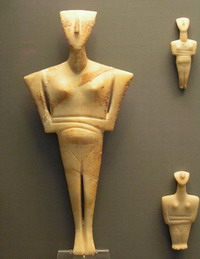
The Photo is an early Cycladic figure found on the island of Sifnos from the National Archaeological Museum of Athens. We know very little about the culture that produced these marble figurines between 2800 and 2300 BC. |
|
|
|
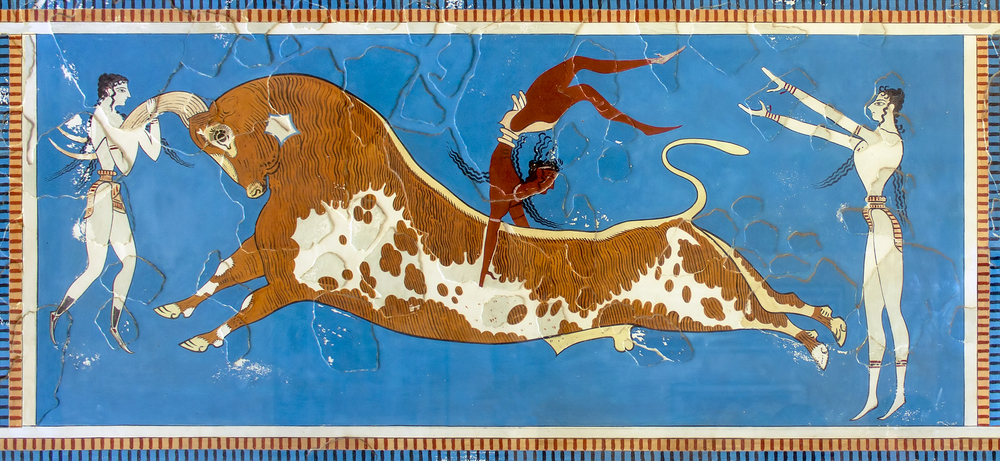
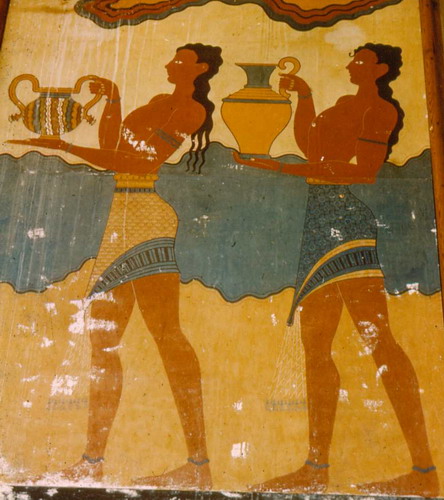
The Palaces themselves were also the centers for economic production with storehouses for grain, wool, oil, and international trade. From artifacts found in excavations we know that the Minoans had contact with some of the other ancient civilizations like the Sumerians and the Egyptians. The fact that the palaces were unfortified shows a confidence in their naval power as their defense against aggression. |
|
|
|
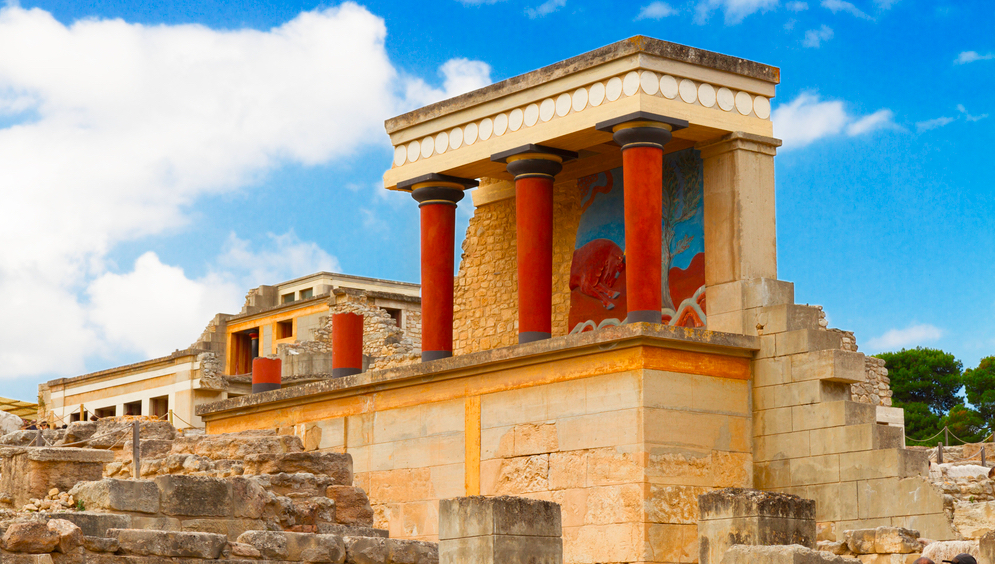
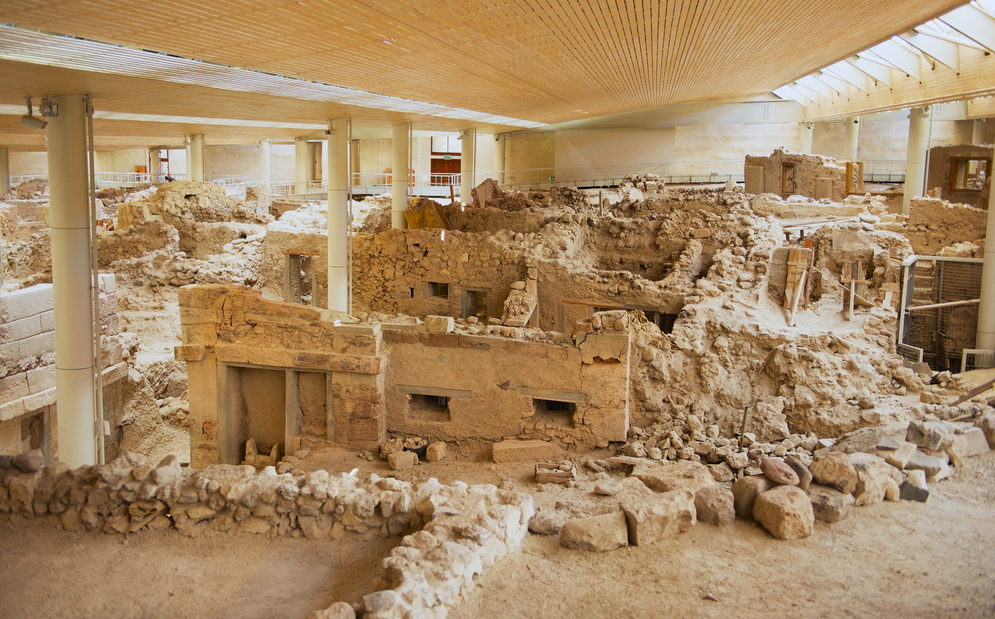
The island of Santorini, or Thira, was one of Crete's primary outposts. Much of this civilization we know from the ruins of Akrotiri as well as the ruined palaces in Knossos and around Crete. These were supposedly destroyed by the eruption of the volcano in Santorini at around 1600 BC which created a massive tidal wave. Some believe it was this wave which destroyed the Minoan civilization, however advances in technology, such as carbon-dating, show that the Minoan civilization did not collapse until around 1450 BC, one hundred and fifty years after the eruption of Thira. So while the calamity may have led to a decline in the fortune of the Minoans (there was certainly plenty of damage and they did lose a trading partner) this was not what destroyed them. According to Plato it was this same wave which wrecked a Greek fleet as it was returning from conquering the Egyptians, which he learned about from Solon. This is all tied in with the theory that Santorini is ancient Atlantis, another story altogether. Besides the large population centers of Crete and Santorini there were smaller independent civilizations on the Aegean islands which were rich in minerals and precious metals. |
|
The problem with understanding the Minoan Civilization is that despite the buildings and artifacts that have been left behind we have no written history or literature of the inhabitants of Crete in the Second Millennium. We can only look at the stones, statues, pottery and painting and try to guess what their society was like and how it came to an end. In short, the Minoan origin is still a mystery and there is a lot more that we don't know as opposed to what we do know. |
|
|
|
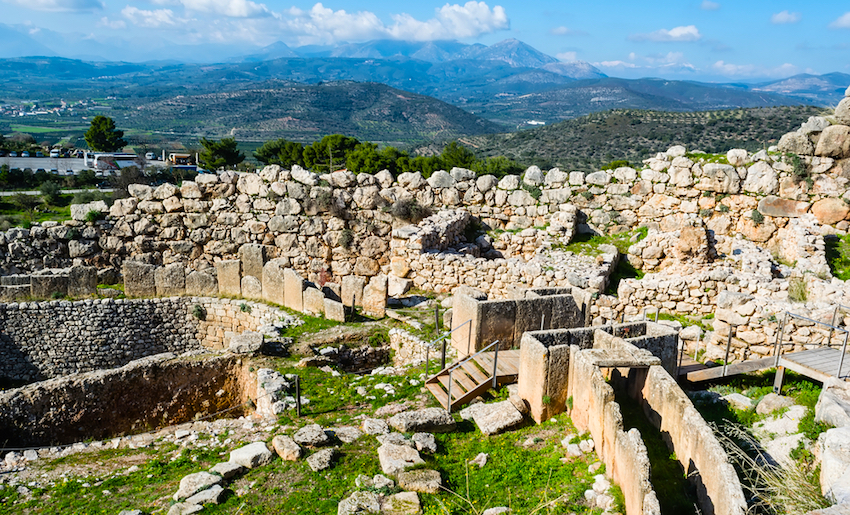
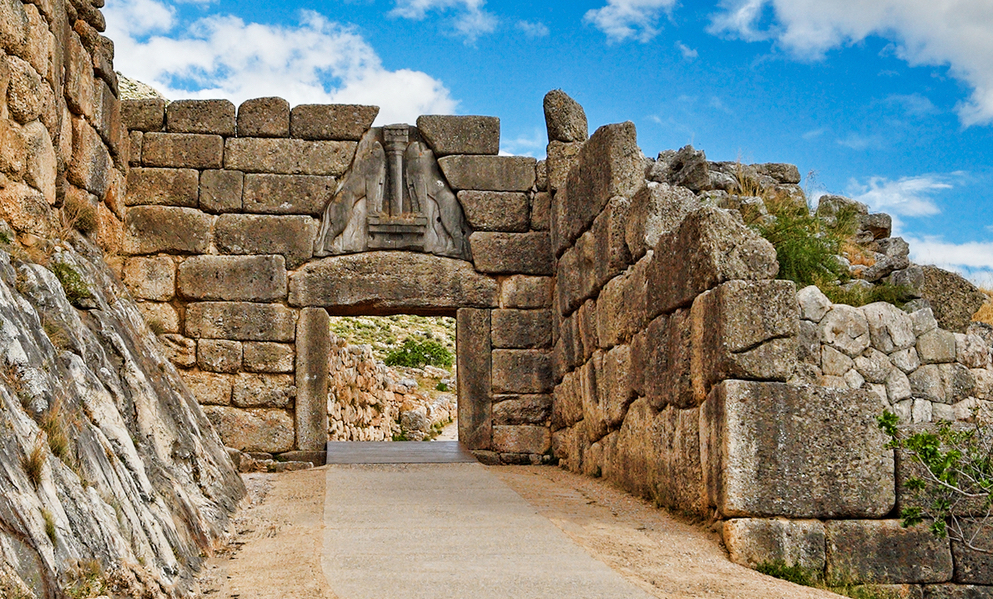
During the same time-period of the Minoans another group known as the Achaean or Mycenaean Civilization centered in the Argolis of the Peloponessos. During the bronze age between 2100 and 1900 BC this area was invaded by people from the east who introduced an advanced culture to the primitive local people who had been there since Neolithic times. These ancient Hellenes had fortresses as far west as Pylos and as far north as Iolcus in Thessaly. The Mycenaean princes used the Linear B script to keep track of possessions and their enterprises throughout the Mediterranean. The walls of their fortresses were made of stones so large that it was difficult to imagine a mortal man lifting them and were therefore dubbed Cyclopean walls, named after the race of one-eyed giants of Homer's Odyssey. |
|
|
|
|
|
It was the Hellenic people from this period who were the Achaean heroes of Homer's Illiad and Odyssey. The Illiad is the epic poem about the abduction by Paris, a Trojan prince, of Helen, wife of King Menelaus of Sparta, and the alliance of Greeks, led by King Agememnon who traveled to the city of Troy (Illium) in Asia Minor and fought for 10 years, eventually destroying the city, just to get her back. The Odyssey is the story of King Odysseus of the island of Ithaki, and his journey home from the war. For many years these stories were thought to have been myth but in 1870 Henrich Schliemann found the ruins of the ancient city and evidence of its destruction during the time period that Homer's epic would have taken place. Truth or fiction, the two books are a fascinating window on a very early period of human history. Preserved orally they were committed to writing in the 8th Century and created a sense of identity among the Greeks, connecting them with their heroic past. |
|
|
|
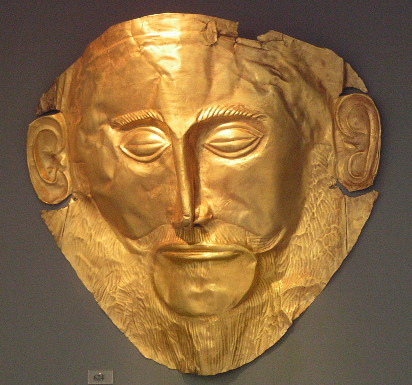
The Mycenaean civilization came to an end sometime around 1200 BC and as was taught to us in our history books was followed by the invasion of the Dorians, who though warlike, brought with them a new culture and what came to be known as The Iron Age. Experts are no longer so sure that this is exactly what happened. What is known from the artifacts found in Mycenae is that they were a wealthy culture who loved gold and objects of beauty. What is also known is that there was a city of Troy which guarded the straits of the Dardenelles, the entrance to the Black Sea, and at about the time of the epic war described in the Illiad, this city was destroyed. It is possible that this ten year war which ended in the defeat of the Trojans, also led to the weakening and destruction of the Mycenaeans, not by invaders but by their own working class. So maybe what we have been calling the Dorian Invasion was an uprising of the peasants and the lower class who saw an opportunity to change the social order. Why not? It has only happened thousands of times since then and will probably happen again many times more. |
|
|
|
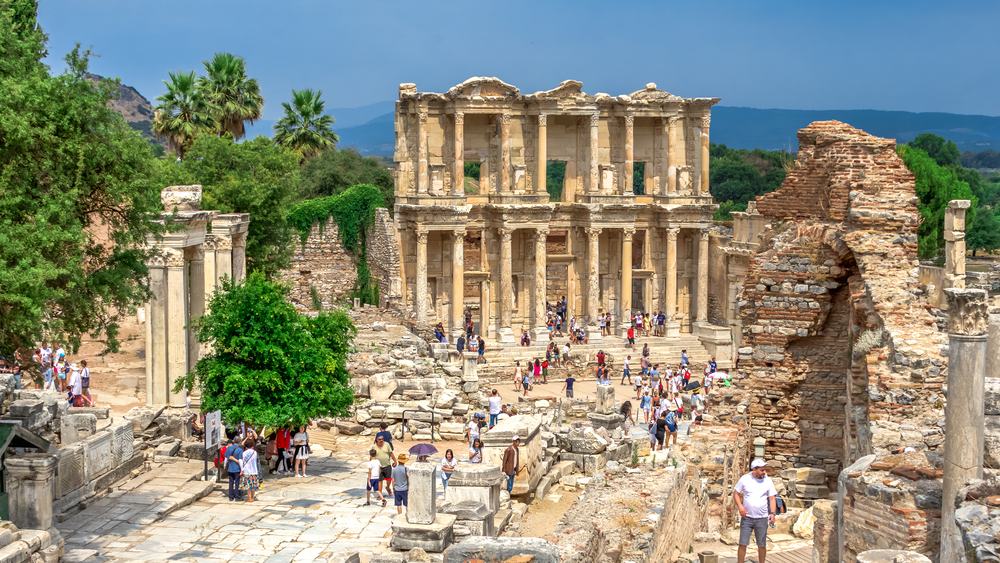
While the Dorians were invading or uprising, the Pelasgians were leaving for the islands and the coast of Asia Minor where they created new cities like Smyrna, Halicarnassus, Samos, Ephesus and Miletus. These city-states brought to mankind science and philosophy as for the first time people had time to reflect on the nature of themselves and their place in the world. As these city-states prospered through trade, more outposts sprung up from the Black Sea to the Western Mediterranean and gave birth to what is known as the Classical period or Golden age of Greece. But before that great awakening is a period known as the Dark Ages which was probably not as bleak as it sounds. Instead of imagining Mordor-like scenes of humans living like wild animals it is more likely that people headed for the hills to escape the dangers in a collapsing society, becoming shepherds and farmers and relying on the extended family instead of the palaces. These clans or households were known as 'oikos' from the word for household in Greek. The clans grew larger and began to develop crafts and trade once again, not just with their neighbors but across the sea. By the 8th century the Greeks are living in cities again, known as polis or city-states. Though autonomous by nature these city-states could come together during a crisis when outsiders threatened the Greeks and it is during these periods that the ancient Greeks emulated the heroes of the Illiad and the Odyssey, who were just as ancient to them as the classical Greeks are to us. As nuclear families became clans which became villages, towns and cities the problem that has plagued Greece through the 20th century appeared: lack of quality farm land and natural resources to support the population. So the Greeks began to export the commodity that they had plenty of and which even up to the twentieth century has been their primary export. They exported themselves, creating colonies as far away as what is now Spain in the west and the Ukraine in the East. Concentrating mostly in the Black Sea, North Africa and the Western Mediterranean these colonies were set up in areas rich in farm land, fresh water and were always close to the sea. As the colonies grew and developed economically the trade routes between them turned the Mediterranean into highways of ships as the Greeks took to the seas. They have been sailors ever since. Where trade routes intersected more colonies were built, most notably in Italy and Sicily which became more wealthy than the mother country. |
|
|
|
It was through colonization and trade that the Greeks came into contact with other cultures such as the Phoenician traders who they crossed paths with in Italy and the eastern Mediterranean. The Greeks had pretty much abandoned writing in the dark ages but during this period of growth used the Semitic alphabet of the Phoenicians to symbolize the sounds of the Greek language. Other ideas filtered into Greek culture from the colonies and their interaction with the local people including the introduction of Eastern Mythology and religious ideas into the Greek myths, notably in the writings of Hesiod whose Theogony is probably the most important evidence of what the ancient Greeks believed, a sort of family-tree of the Gods written in verse form. (For more info see Richard Caldwell's Translation of Hesiod's Theogony which is probably the best unraveling of the poem). This is known as the oriental-izing period and evidence of this can be found in their art. For an interesting theory on the influences from the east on Greek art and culture with thousands of photos comparing Greek-Chinese and other cultures visit the website of Theresa Mitsopoulou. |
|
Another interesting theory concerns the Palestinians* or as they are known in the Bible, the Philistines. The theory is that the Philistines were in fact the survivors of the Greek-Dorian conquest of Crete in 1200 BC and that these Minoans fled by sea to the Libyan coast and from there tried to gain a foothold in Egypt and failed and then went on to Canaan where they arrived just about the time that the Israelites moved in as well. Another theory is that they were survivors of the Troy expedition who lost their way home. Neither theory has real base and are only theories actually… but it is interesting as essentially it means that if the Palestinians failed to get what they wanted in Gaza they could always start claiming that Crete was their national homeland! Imagine what a mess that would be. Theory or reality it could explain the affinity the Greeks have for the Palestinians and vice-versa. *Actually, until 1948 the word Palestinian referred to the Jewish settlers of the area. The Arabs who lived in what is now (mostly) Jordan and Israel always referred to themselves as Syrians. |
 The
Mycenaeans and the Minoans were probably economic competitors in
the Mediterranean. Sir Arthur Evans believed that the Minoans had
colonized the mainland and the Mycenaeans were really part of that
civilization. Others believed that the Mycenaeans were a totally different
culture and the artifacts that suggest Minoan influences were actually
acquired in trade. In 1952 Michael Ventris, an English architect and classical
scholar, deciphered the Linear B tablets found by Evans in Crete. Evans
himself had spent much energy trying to decipher these while
at the same time insisting they were not Greek but a 'Minoan' language.
Ventris discovered that the language actually was Greek which
proved that at least the later period of Minoan civilization came
from the Mycenaeans. So instead of the Mycenaeans being an offshoot
of the Minoans, the most likely scenario seems to be that they were
contemporaries. If the lack of fortifications around the Minoan
cities suggests that their walls were their fleets which ruled the
seas, maybe the eruption of Thira which caused great damage to their
cities with its tsunami, also destroyed their ships. With the Cretan
fleet decimated there was little to keep the Mycenaeans from invading,
occupying and closing out the last period of what we call Minoan
Civilization.
The
Mycenaeans and the Minoans were probably economic competitors in
the Mediterranean. Sir Arthur Evans believed that the Minoans had
colonized the mainland and the Mycenaeans were really part of that
civilization. Others believed that the Mycenaeans were a totally different
culture and the artifacts that suggest Minoan influences were actually
acquired in trade. In 1952 Michael Ventris, an English architect and classical
scholar, deciphered the Linear B tablets found by Evans in Crete. Evans
himself had spent much energy trying to decipher these while
at the same time insisting they were not Greek but a 'Minoan' language.
Ventris discovered that the language actually was Greek which
proved that at least the later period of Minoan civilization came
from the Mycenaeans. So instead of the Mycenaeans being an offshoot
of the Minoans, the most likely scenario seems to be that they were
contemporaries. If the lack of fortifications around the Minoan
cities suggests that their walls were their fleets which ruled the
seas, maybe the eruption of Thira which caused great damage to their
cities with its tsunami, also destroyed their ships. With the Cretan
fleet decimated there was little to keep the Mycenaeans from invading,
occupying and closing out the last period of what we call Minoan
Civilization.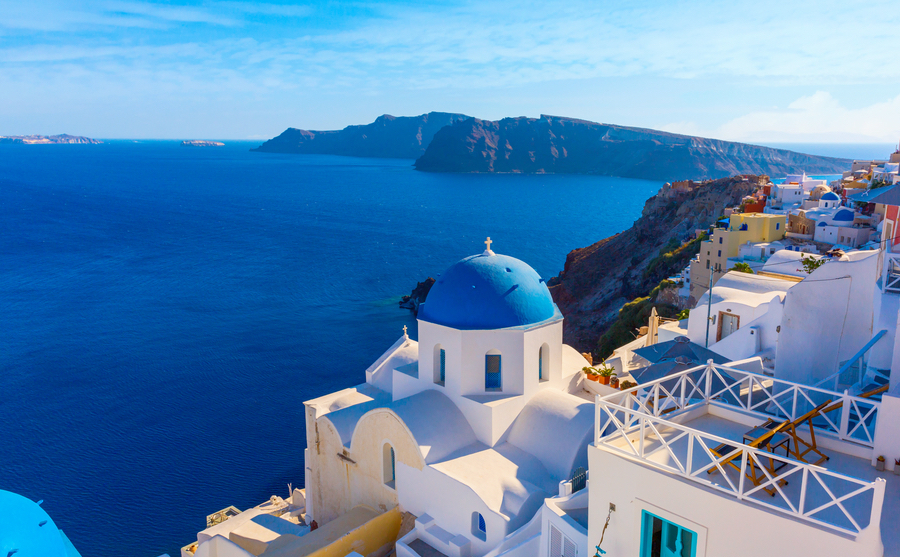
|
|
|
Help Support Matt's Greece Guides Join Matt Barrett's Greece Travel Guides Group on Facebook for comments, photos and other fun stuff. If you enjoy this website please share it with your friends on Facebook and other social media. |

